Drivers of institutional evolution: phylogenetic inertia and ecological pressure
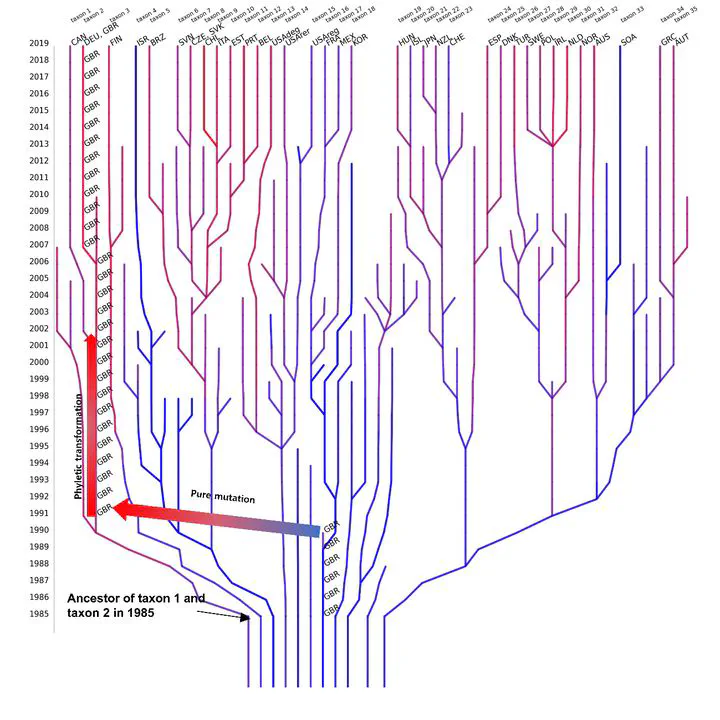 Image credit: Unsplash
Abstract
Understanding dynamics on institution for sustainable development of society is a topical issue. Researchers in the past have qualitatively analyzed factors, such as inertia, that influence institutional evolution. This study proposes a quantitative approach. Using algorithms, we establish a phylogenetic tree based on data from the power sector institution of OECD countries during 1985–2019. Our results are verified by historical events in power sector institutions, such as the global change to a privatized competitive market and institutional revolution of the United Kingdom in 1990. We propose two quantitative measurements based on this tree - institutional inertia (which resists change) and ecological pressure (which causes change). Both institutional inertia and ecological pressure alter the dynamics of institutional evolution to be either gradual or rapid, respectively. Specifically, inertia causes a pattern shift from phyletic gradualism to punctuated equilibrium due to its diverse effect on institutional evolution. In the phyletic gradualism pattern, it suppresses rapid institutional change; however, it becomes stronger endogenously as institutions evolve and shifts the pattern to punctuated equilibrium. Using the phylogenetic tree to simultaneously analyze gradual and rapid institutional change is novel.
Type
Publication
In Journal of Evolutionary Economics