Mapping the evolutionary pattern of mobile products: a phylogenetic approach
Jan 1, 2024·,,,,,,·
0 min read
Jeong-Dong Lee
Dawoon Jeong*
Euy-Young Jung
Yunyoung Kim
Jiyong Kim
Youwei He
Sungjun Choi
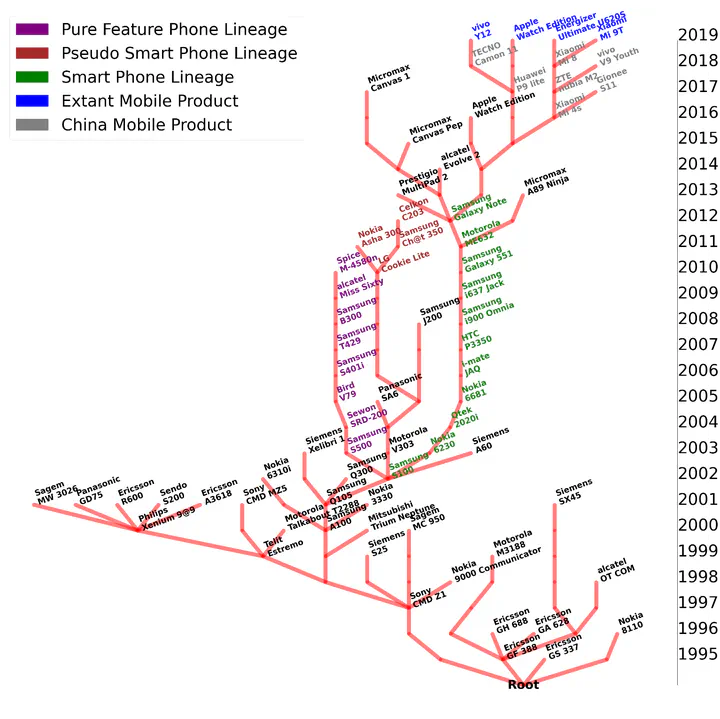 Image credit: Unsplash
Abstract
Product evolution is an emerging research field with increasing academic and practical interest. Although there have been several qualitative and quantitative studies on product evolution, a consensus on operational definitions and generalized methodology for analyzing product evolution has not been reached. Therefore, operational definitions of product gene, product taxon, and ancestor–descendant relationship are presented in this article. Based on the definitions, a unique product phylogenetic tree methodology is introduced considering the differences in biology and products. The methodology can be applied to any product data because it comprises generalized algorithms. To verify the definitions and methodology, a mobile product phylogenetic tree is constructed using the web crawled global mobile product data released between 1995 and 2019. The definitions and methodology were verified by observing historical events, such as emergence of smartphone and growth of Chinese firms on the resulting tree. In addition, three application methods of the methodology are introduced—a tool to explain evolutionary phenomena in a product along with previous product evolution theory, a tool to inform firms of decision making for determining their strategies, and a tool to predict the future product type. In summary, the findings of this study can contribute to the improvement of product evolution research by introducing data-driven and algorithmic approach for analyzing product that can be utilized in future studies. Furthermore, the proposed methodology aids decision making in product development by providing trajectories of products that are expected to survive.
Type
Publication
In IEEE Transactions on Engineering Management